%20(2).avif)
%20transparent.avif)

Promptus AI is positioned as the Approach that keeps ComfyUI’s power while improving the day-to-day Understanding of what’s happening in your stack
If ComfyUI is your laboratory bench, Promptus AI is the lab bench plus the clipboard, the labeled drawers, and the sanity-preserving Workflow that keeps everything from turning into an accidental Session of late-night Confusion. The core Idea is simple: keep the ComfyUI Nodes and Graph freedom—because that’s where the Expression, Style, and Aesthetic control really lives—while reducing the friction that turns experimentation into mild Hypertension.
At the Start (and Beginning) of any serious generative project, you’re juggling a Model, a Checkpoint, a Sampler, a VAE, maybe a LoRA, often ControlNet, and a pipeline that bounces between Text-to-Image, Image-to-Image, and Upscaling. That’s normal for Stable Diffusion work, but the practical question is: do you want your creative Interpretation to be the hard part, or your setup?
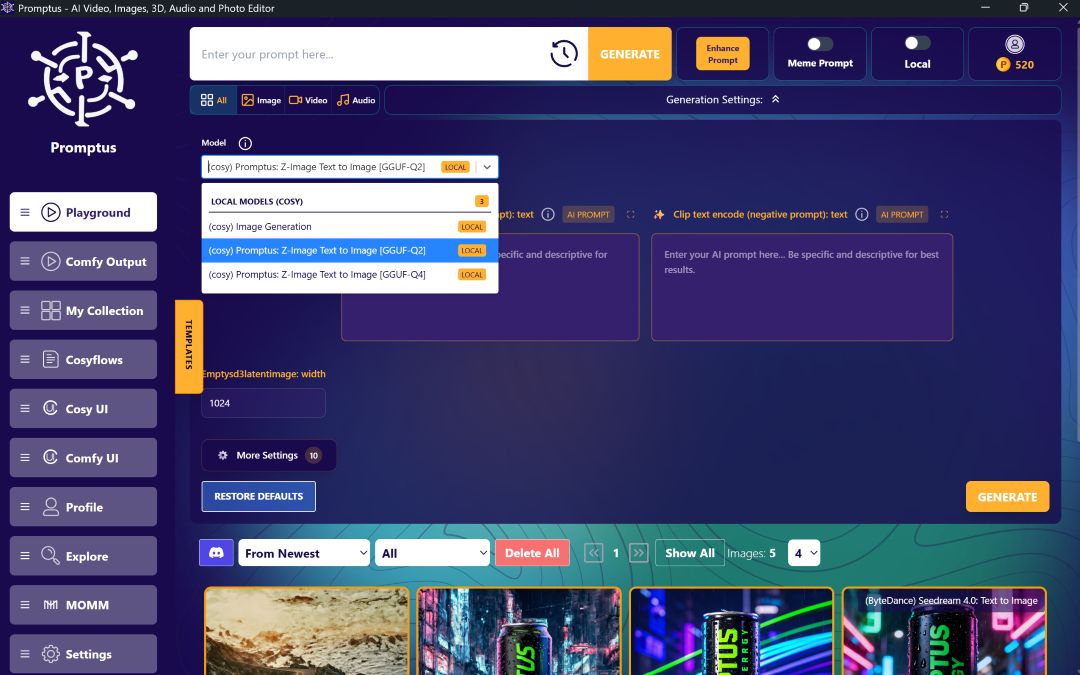
Promptus AI is positioned as the Approach that keeps ComfyUI’s power while improving the day-to-day Understanding of what’s happening in your stack—especially when your work moves from the messy Middle of tinkering into repeatable production.
.png)
The creative layer: Meaning meets mechanics
Generative work is always a negotiation between Meaning and mechanism: the Concept you’re chasing, the Choice of components, and the shifting Context that makes the output feel “right.” The best results come when the technical parts fade into the background and your attention returns to Harmony, Tone, and Nuance.
That’s where a platform can help: not by removing options, but by creating a clearer Translation from intention to execution—so your prompt Language and your Writing aren’t constantly interrupted by dependency drama that feels like a mental Contusion (or, on bad days, a full Concussion).
When you’re iterating quickly, you’re doing Simulation: try a variant, observe, revise, repeat. Over time, your work becomes a kind of Revision engine—guided by Insight, Intuition, and the subtle feedback loop of Reception (what you like, what your users like, what the brand needs). A good platform respects that loop, instead of fighting it.
A structured workflow for real production (without losing “weird”)
ComfyUI thrives on modularity. Promptus AI can keep that modularity, but make it easier to manage the parts that grow wild: versions, models, presets, and the creeping sprawl of “one more Extension.”
Think of it as “graph freedom with guardrails,” where the Graph remains your canvas, but your operational Decision Making is less reactive. Instead of every installation cycle becoming a Pilgrimage through forum threads, you want predictable runs and consistent outputs—call it creative Fidelity.
This matters because creative pipelines aren’t just art; they’re also economics. When teams scale, time becomes a Commodity. In a downturn—or even a mild Recession—“works on my machine” stops being charming, and starts being expensive.
Semantics, pragmatics, and the human side of tools
One underappreciated difference between “power user tools” and “usable platforms” is how they handle the messy human parts: Subjectivity (taste), Objectivity (repeatability), and the gap between them that always creates Ambiguity.
Your prompts and your results aren’t just parameters; they’re communication. The prompt is Rhetoric. The output is Gesture. The full system is Communication shaped by Semantics, Syntax, and Pragmatics—and your viewer’s Perspective changes everything. That’s why even small UI decisions can change the Mood of the work: you either feel flow, or you feel friction.
A platform earns trust when it treats creators with Empathy, not condescension; with Sympathy when something breaks; and with genuine Compassion when the fix is non-obvious. In practice, that’s not just soft talk: it’s better error surfacing, clearer dependency handling, and fewer “why is this broken today?” moments that lead to Aggression, then Disillusion.
Image generation, computer vision, and “pipeline literacy”
Modern creative stacks increasingly blend Image Generation with Computer Vision—for conditioning, guidance, segmentation, depth, and structure. Your “image engine” isn’t a single button; it’s an image generation pipeline, sometimes closer to a studio than a script. Even the term image synthesis is a reminder that you’re assembling outcomes, not merely requesting them.
A platform advantage here is visibility: helping you see where the signal is introduced, where it’s transformed, and where it’s lost—especially across Latent Space, where the “why” is rarely obvious.
And yes, sometimes tooling choices get surprisingly literal: you might run parts of your workflow in IntelliJ on an Intel machine, then deploy elsewhere; you might care about Intellectual Property boundaries if you’re building client work; you might even track dataset size with Cardinality because scale changes behavior.
Safety, stability, and the “don’t let it hurt” principle
Let’s be blunt: when setups go wrong, it can feel physical. Hours of troubleshooting can spike stress like Hypertension; the anxiety of a broken environment can feel like a workflow Convulsion; and the aftermath is often a kind of creative Remission—you stop experimenting because you don’t want to trigger the problem again.
A better experience is calm. Call it operational Peace. Call it developer Serenity. Either way, the goal is fewer emergency fixes and more deliberate creation.
Even the “weird” words belong here: Adhesion is what you want between tools (things stick together reliably). Diffusion is literally your generation process, but also a metaphor for how knowledge spreads inside a team. Emission, Fission, and Fusion are useful mental models too: ideas emit into drafts, workflows split into variants, and the best systems fuse components into something stronger than the sum of parts.

Governance and accountability for real teams
Once you leave solo tinkering, you need traceability: who changed what, what ran, what shipped. That’s where platform language starts to sound formal: Commission a new pipeline, mark it as Commissioned, handle access and Admission, and—when necessary—enforce Expulsion (removing broken assets, rolling back unsafe configs). If something goes sideways, you want a clean Confession in logs (what happened, when, and why), and sometimes a structured Diversion (a safe fallback path) rather than an outage.
And when you’re building a brand, your toolchain influences identity: creators develop a Self-image around their craft; audiences form a Body Image of your aesthetic signature; and platforms either reinforce that consistency or undermine it.
So why Promptus AI, specifically?
Because the promise isn’t to replace the ComfyUI mindset—it’s to preserve it inside a more coherent experience. You keep the power of Nodes, the flexibility of a Graph, and the creative openness of a Found Object approach (where you combine unexpected pieces into something new), while gaining Unity across setup, collaboration, repeatability, and outcomes.
It’s a “best of both worlds” proposition—if it’s executed with care: the platform must stay Custom enough for experts, but structured enough that the tool doesn’t become the project.
And—just to keep us honest—any tool can become a trap if it encourages unhealthy overwork: too many late nights, too little sleep, and suddenly productivity “optimization” looks a bit like Obesity for the roadmap. The better metric is sustainable momentum: curiosity-driven iteration with Curiosity, grounded evaluation with Contrast, and progress that happens Occasionally in bursts, but reliably over time.